Architecture
The core thesis of Soma is that an agent run is not a function that calls tools in a loop — it is a supervised OTP process tree. Erlang/OTP provides the execution semantics (timeouts, cancellation, monitoring, crash isolation, restart policy); the step list only says what to run.
The mental model is the actor model plus OTP supervision: every session, run, and tool call is an actor — an isolated process with a private mailbox, communicating only by message passing — and OTP’s supervision and monitors add the fault-tolerance layer that is the actual thesis.
The supervision tree
Section titled “The supervision tree”The runtime lives under soma_sup, and the agent-entity layer lives in a
separate app above it with a one-way dependency.
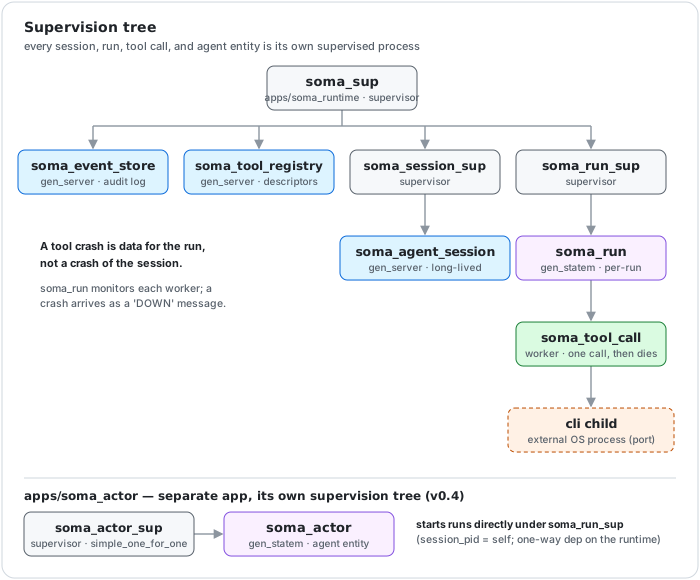
soma_sup                                        (apps/soma_runtime)  ├── soma_event_store  ├── soma_tool_registry  ├── soma_session_sup → soma_agent_session   (gen_server, long-lived)  └── soma_run_sup     → soma_run             (gen_statem, per-run)                            └── soma_tool_call  (per-tool-call worker, disposable)
soma_actor_sup                                  (apps/soma_actor; simple_one_for_one)  └── soma_actor                              (gen_statem, long-lived agent entity)
The load-bearing processes
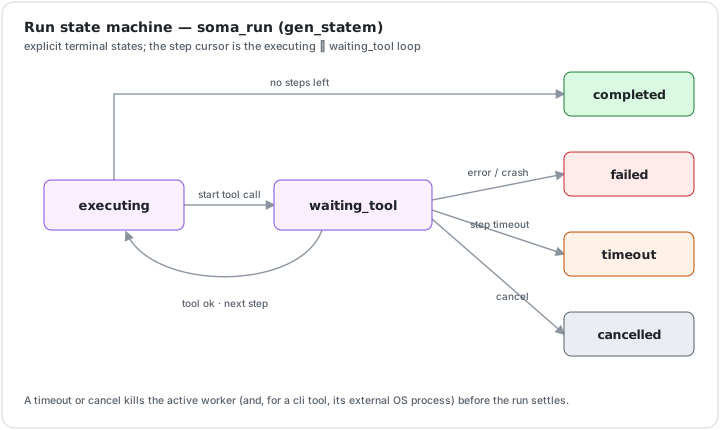
Section titled “The load-bearing processes”soma_agent_session(gen_server, long-lived) ownssession_idand session metadata, accepts run requests, startssoma_runundersoma_run_sup, tracks active runs, and must survive failed, timed-out, or cancelled runs. It never executes tool logic directly.soma_run(gen_statem, short-lived) owns one execution attempt — the step cursor, step results, the active tool-call pid, the run timeout timer, cancellation, and event emission. Terminal states are explicit:completed | failed | cancelled | timeout. Steps are iterated insidesoma_runitself; itsexecuting/waiting_toolstates are the step cursor, so there is no separate per-step process.
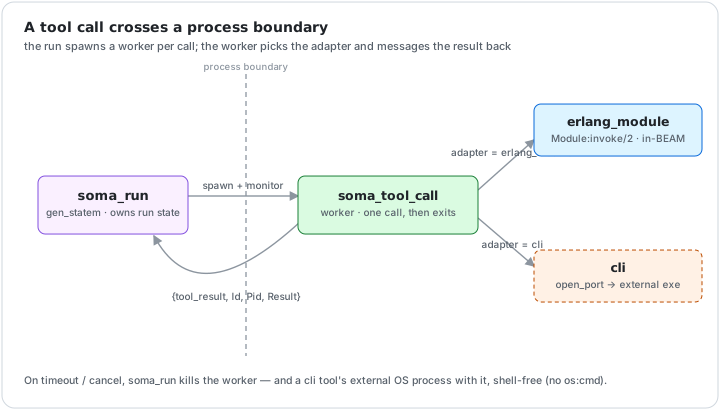
soma_tool_call(disposable worker) executes exactly one tool invocation, returns a result or error message tosoma_run, then dies. Every tool invocation crosses a process boundary.
Non-negotiable constraints
Section titled “Non-negotiable constraints”These are the design’s whole point:
- Every tool invocation crosses a process boundary; tool results come back
to
soma_runas messages. soma_runowns run state; tools never mutate run state directly.soma_agent_sessionnever executes tools.- Cancellation is real, not a flag checked at the end: a cancel message
reaches
soma_run, which stops or kills the active tool-call process, recordsrun.cancelled, and leaves the session alive. - Failure isolation is modeled with processes, links, monitors, and supervision
— not a pile of defensive
try/catch.